Sprache

Land

  • +1 800-716-3167
  • Einloggen
  • Warenkorb (0)
  • Kasse
  • Heim
  • Geschäft

    Nach Kollektionen einkaufen  

    Meistverkauft
    Leuchter
    Pendelleuchte
    Deckenleuchte
    Deckenventilatorlicht
    Tischlampe
    Stehlampe
    Wandlampe
    Outdoor Lights
    Zubehör

    Nach Zimmern einkaufen  

    Schlafzimmer
    Wohnzimmer
    Höhle/Studie
    Esszimmer
    Flur
    Küche
    Eingang/Foyer
    Kommerzielle Vermittlung
    Kücheninsel-Serie

    Nach Farben einkaufen  

    Charging Lamp
    Candle Warmer Lamp
    Sculpture Collections
    Plug-In Pendant Lamp
    Murano Glass Collections
    Plug-In Wall Lamp
    Swing Arm Pendant Lamp
    Floral Lighting Collection

    Einkaufen nach Material  

    Glas
    Messing
    Pop Art Inspired
    Harz
    Metall
    Memphis Lighting
  • Blog
  • Kontakt
  • Unsere Geschichte 
    • About Us
    • Customer Reviews
  • 3D MAX
  • Lighting Projects
  • Sprache

    Land

  • Heim
  • Geschäft
  • Nach Kollektionen einkaufen  

    Meistverkauft
    Leuchter
    Pendelleuchte
    Deckenleuchte
    Deckenventilatorlicht
    Tischlampe
    Stehlampe
    Wandlampe
    Outdoor Lights
    Zubehör

    Nach Zimmern einkaufen  

    Schlafzimmer
    Wohnzimmer
    Höhle/Studie
    Esszimmer
    Flur
    Küche
    Eingang/Foyer
    Kommerzielle Vermittlung
    Kücheninsel-Serie

    Nach Farben einkaufen  

    Charging Lamp
    Candle Warmer Lamp
    Sculpture Collections
    Plug-In Pendant Lamp
    Murano Glass Collections
    Plug-In Wall Lamp
    Swing Arm Pendant Lamp
    Floral Lighting Collection

    Einkaufen nach Material  

    Glas
    Messing
    Pop Art Inspired
    Harz
    Metall
    Memphis Lighting
  • Blog
  • Kontakt
  • Unsere Geschichte 
    • About Us
    • Customer Reviews
  • 3D MAX
  • Lighting Projects
  • Sprache

    Land

Nachricht

🚿Mastering Bathroom Lighting: A Complete Guide to Functional and Beautiful Lighting Solutions

Dezember 30, 2025

We’ve all been there: You look in the bathroom mirror to get ready, but the light casts deep shadows under your eyes, making you look tired. Or perhaps you’re trying to relax in the bath, but the overhead light is so bright and clinical it feels like a hospital exam room.

Designing a bathroom lighting scheme is a science. It requires a balance of ambiance, functionality, and visual comfort. In this guide, we’ll break down how to light every corner of your bathroom so you can transform your space into a functional sanctuary.

1. The Secret of the "Three Layers"

Professional lighting designers never rely on a single light source. To make a bathroom truly work, you need to layer your light:

  • Task Lighting (The Functional Layer): This is the most critical. It’s the light you use to shave, apply makeup, or brush your teeth. It needs to be bright and shadow-free.
  • Ambient Lighting (The Foundation): This provides the general illumination for the room, usually via a central pendant or recessed ceiling lights.
  • Accent Lighting (The Aesthetic Layer): This adds the "wow" factor. It highlights beautiful tiles, a niche, or a vanity unit, creating depth and a "spa-like" feel.

2. How to Choose Lighting for Different Areas of Your Bathroom

Lighting isn’t a one-size-fits-all solution. Different bathroom areas require different types of lighting to meet their functional needs while contributing to the overall aesthetic of the space. Let’s break down how to choose the right lighting for each area:

-Vanity Area (Task Lighting):

For the vanity, you need bright, shadow-free light for grooming tasks. Wall-mounted sconces on either side of the mirror or overhead lighting can work, but avoid recessed lights above the mirror, as they create unwanted shadows.

Best Options for Vanity Lighting:

  • Wall-mounted sconces: Placing wall sconces on either side of the mirror is one of the best ways to eliminate shadows. These fixtures are perfect for creating even light across the face, ensuring a well-lit reflection for tasks like makeup application or shaving.

  • Vanity bars: A horizontal light bar placed directly above the mirror, though it can help illuminate the area, may still create some shadows. However, combining it with other lighting can provide a balanced solution.

  • Pro Tip:If you are using wall sconces, mount them roughly 150cm to 160cm (60-64 inches) from the floor. This is the "sweet spot" that ensures the light hits your face directly, rather than from above, avoiding troublesome shadows.

-Shower Area (Lighting for Wet Areas):

The shower area needs to be brightly illuminated while also offering a relaxing ambiance. Ceiling-mounted lights are great for providing general lighting in this area.

Best Lighting Fixtures:

  • Ceiling-mounted lights: These are ideal for the shower area. A well-placed ceiling fixture will light the space effectively without being too harsh. If you want a relaxing vibe, choose softer, dimmable lights.
  • Pro Tip: Install the ceiling light far enough from the showerhead to avoid glare, and choose a light with a neutral color temperature to create a calm environment.

-Overall Bathroom Lighting (Ambient Lighting):

Ambient lighting provides general illumination for the room, ensuring that all areas are well-lit. This is the base layer of your lighting scheme.

Best Lighting Fixtures:

  • Ceiling-mounted lights: These are the most common and efficient option for providing overall illumination. They work well in both large and small bathrooms and offer a clean, modern look. Choose fixtures that blend with your bathroom's design.
  • Pro Tip: For larger bathrooms or those with higher ceilings, you can consider using larger ceiling-mounted lights to ensure enough light coverage.

-Accent Lighting (Highlight Features):

Accent lighting can be used to highlight beautiful features in your bathroom, like tile patterns, mirrors, or art pieces.

Best Lighting Fixtures:

  • Wall washers: Install these on the walls to highlight interesting textures or decorative elements.
  • LED strips: These can be installed along the edge of mirrors or under vanities to add soft light and create an elegant, spa-like atmosphere.

3. The Science of Light: CRI and Color Temperature

This is the difference between a "cheap" look and a "designer" look. These two parameters are the soul of interior lighting.

CRI (Color Rendering Index):

CRI measures how accurately a light source reveals true colors.

The Rule: For bathrooms, always choose fixtures with a CRI of 90 or higher. A high CRI ensures that your skin tones look natural and makeup appears true to color, so you can be confident in your appearance.

Color Temperature (Kelvin):
  • 4000K (Neutral White): Ideal for the vanity. It mimics natural daylight, helping you stay alert and see details clearly.
  • 2700K - 3000K (Warm White): Perfect for the evening. If you enjoy a relaxing bath, warm light helps your body relax and prepare for sleep.

Tip: Using the right color temperature in the bathroom can enhance both your mood and functionality.

4. Placement Math: Finding the Perfect Proportions

Choosing a light that is too big or too small can ruin the visual balance of your bathroom. Follow these designer "Rules of Thumb":

  • The 75% Rule: If you are placing a horizontal light bar above your mirror, it should be approximately 75% of the mirror’s total width. It should never be wider than the mirror itself.
  • The 4-Inch Rule: If you are using side sconces, try to keep them at least 4 inches (10cm) away from the edge of the mirror to prevent the space from looking crowded.
  • Small Bathrooms: For tiny powder rooms, a single beautiful pendant or a pair of slim vertical sconces can provide enough light while acting as a stunning focal point.

5. Common Pitfalls to Avoid
  • Forgetting a Dimmer: Dimmer switches are the ultimate bathroom luxury. They allow for bright light during your morning routine and soft, low light for a relaxing midnight bath.
  • Ignoring the Finish: Ensure your light fixture’s hardware (brass, matte black, or chrome) complements your faucets and cabinet handles for a cohesive, high-end look.
  • Over-Lighting: You want a spa, not a stadium. Use lower-wattage bulbs across multiple fixtures rather than one extremely bright bulb in the center of the ceiling.
Final Checklist Before You Upgrade:
  • Is the light at eye level for the vanity?
  • Is the CRI 90+ to ensure natural skin tones?
  • Are the proportions balanced with your mirror size?
  • Do you have a warm light option for evening relaxation?

Conclusion:

Choosing the right lighting for your bathroom is essential for creating both a functional and aesthetically pleasing space. From vanity lights to shower lighting, each area requires specific lighting solutions to ensure safety, comfort, and style. By understanding your needs and selecting the appropriate fixtures, you can transform your bathroom into a well-lit, welcoming space.

Visit Docos today to explore our wide range of lighting options and find the perfect lighting to suit your style and needs! 

Vollständigen Artikel anzeigen

✨ Illuminate Your Home with Ceramic Wall Lamps: Create a Warm and Artistic Ambiance

Dezember 29, 2025

Wall lamps are not just functional lighting solutions; they are key elements in decorating your space. Today, we're excited to recommend several ceramic wall lamps that not only bring a warm glow to your home but also add a touch of artistic flair. Whether in the bedroom, living room, hallway, or dining area, ceramic wall lamps can enhance your home with their unique aesthetic. Let’s explore these carefully curated pieces that will help transform your living space into an artful haven.

Why Choose Ceramic Wall Lamps? 🧐

Ceramic wall lamps are more than just lighting fixtures—they serve as decorative elements that can elevate any room. Ceramic, with its distinct texture and soft lighting effects, has become an essential material in modern home design. Here are the advantages of choosing ceramic wall lamps:

1. Warm Texture and Soft Lighting 

The ceramic material diffuses light softly, creating a warm, cozy atmosphere perfect for relaxing. Ceramic wall lamps fill every corner of your home with gentle light, offering a tranquil and soothing ambiance. 

2. High Aesthetic Appeal and Decoration 

Many ceramic wall lamps are designed with intricate details, functioning not only as lighting but also as pieces of art. Their unique shapes and textures make them standout features in your space, adding visual interest and style. 

3. Versatility for Various Home Styles 

Whether you prefer modern minimalism, classic elegance, or artistic decoration, ceramic wall lamps can seamlessly integrate into any home style. Their neutral tones and textures harmonize with various décor themes, adding depth and charm to your space. 

1. Saba Wall Lamp - A Perfect Blend of Modern Simplicity and Art 🎨

Saba Wall Lamp features a soft, flowing design with elegant lines. The lampshade's streamlined shape offers a modern yet artistic touch, making it ideal for use in the living room or hallway as a focal lighting piece. 

Why We Love It:

  • Modern Simplicity: Its simple lines and pure ceramic texture blend effortlessly into modern interiors, adding an artistic vibe to your space. 
  • Multiple Color Choices: Available in beige, brown, red, and green, allowing you to pick the perfect shade to match your home’s aesthetic. 
  • Ideal Spaces: Perfect for corridors, living rooms, or offices, providing ample light while also serving as a beautiful art piece. 

Detail Close-Up:

  • Exquisite Textures: The Saba Wall Lamp's ceramic lampshade features fine textures, handcrafted with meticulous attention to detail, making each piece one-of-a-kind. 

2. Porcelain Indigo Wall Lamp - The Perfect Fusion of Vintage and Modern 🔮

Porcelain Indigo Wall Lamp uses a deep blue porcelain glaze that blends vintage and modern design elements. This lamp is full of personality, combining traditional ceramic craftsmanship with a modern minimalist style, making it a bold statement piece for your home. 

Why We Love It:

  • Vintage Style: The porcelain glaze evokes classic Chinese influences, while the sleek design suits modern interiors. 
  • Ideal Spaces: Perfect for dining areas or reading corners, adding a touch of classic elegance to any room. 

Detail Close-Up:

  • Porcelain Glaze Finish: The lamp’s ceramic surface is coated with a delicate porcelain glaze, creating a sophisticated, old-world charm that makes it a standout piece in your home. 

3. Celine Wall Lamp - Diverse Designs to Suit Every Home 🌸

Celine Wall Lamp offers a range of unique designs, each bringing its own charm and style. With four different design options, Celine wall lamps cater to various tastes, whether you prefer simplicity, vintage flair, or luxurious decorative elements. These lamps are perfect for adding an artistic touch to any room, from the living room to the bedroom.

Why We Love It:

  • Versatile Designs: With four distinct styles, Celine wall lamps can easily match various home decor, offering a perfect solution for any space. 
  • Ideal Spaces: Whether placed in the living room, bedroom, or hallway, Celine wall lamps elevate the ambiance with their unique charm. 

Detail Close-Up:

  • Exquisite Craftsmanship: Each Celine wall lamp features intricate details and high-quality ceramic craftsmanship, creating a refined and artistic lighting effect. 

4. Bellewave Wall Lamp - A Modern Art Sculpture in Light 🎭

Bellewave Wall Lamp features a wave-shaped ceramic lampshade that delivers a dynamic, sculptural feel. It’s a bold statement piece, offering functional lighting while infusing artistic energy into your space. 

Why We Love It:

  • Dynamic Design: The wave-shaped design makes the lamp look like a piece of modern art, offering a unique aesthetic to your space. 
  • Ideal Spaces: Perfect for corridors, living rooms, or any area that needs a touch of artistic expression and vitality. 

Detail Close-Up:

  • Wave Design: The intricate wave-shaped lampshade allows light to filter softly and creates a layered effect, making it a stunning addition to any art-filled space. 

5. Bellis Wall Lamp - Elegant Simplicity with a Modern Twist 🏆

Bellis Wall Lamp comes in two refined designs, both offering an elegant combination of simplicity and modern flair. Each design comes with two metal finishes: gold and chrome, allowing you to choose the perfect finish for your space. 

Why We Love It:

  • Classic Design: The Bellis Wall Lamp’s bell-shaped lampshade offers timeless elegance and fits seamlessly into modern home décor. 
  • Color Choices: Available in gold and chrome finishes, you can easily find the perfect match for your home’s aesthetic. 
  • Ideal Spaces: Perfect for bedrooms, corridors, or small living rooms, this lamp adds warmth and elegance to any setting. 

Detail Close-Up:

  • Exquisite Lampshade: The bell-shaped lampshade is designed with smooth ceramic and gold or chrome detailing, casting soft light while providing a delicate touch of sophistication. 

How to Install Ceramic Wall Lamps: Practical Tips 🔧

When installing ceramic wall lamps, consider the following tips to ensure the best results:

  • Installation Height: Wall lamps should be installed at a height appropriate for the space. For example, bedroom wall lamps should be placed next to the bed, while living room lamps can be positioned on the wall beside the sofa. 
  • Lighting Direction: Ceramic wall lamps naturally diffuse light, making them perfect for ambient lighting. Adjust the angle of the lampshade during installation to ensure an even, soft glow. 
  • Style Coordination: Choose the color and style of your wall lamp based on your room’s existing colors and furniture to create a cohesive look. 
Conclusion: Let Ceramic Wall Lamps Light Up Your Home 🌈

Ceramic wall lamps are more than just lighting fixtures—they are essential elements in home decoration. By carefully selecting and pairing these exquisite ceramic lamps, you can effortlessly add art, warmth, and personality to your home. From classic to modern, small to luxurious, each lamp brings its own emotional value to any room. 

Ready to transform your space? Visit our website and find the perfect ceramic wall lamp for your home today! ✨

Shop Now at Docos🛒

Vollständigen Artikel anzeigen

Kitchen Island Pendant Spacing Guide: How Many Lights Do You Need?

Dezember 24, 2025

A kitchen island can look “designer-done” with the same lights—just by getting three things right: how many, where they hang, and how low. This guide gives you a quick, copy-and-paste method you (or your installer) can follow in minutes.

⚡The 30-Second Cheat Sheet

  • End margin: leave 8–12 in (20–30 cm) from the island end to the pendant edge
  • Gap between pendants: leave 8–12 in (20–30 cm) from pendant edge to pendant edge
  • Hanging height: pendant bottom 30–36 in (75–90 cm) above the countertop

If you do only these three, your island almost always looks balanced.

Step 1: Pick the Number of Pendants 

Start with island length L:

  • ≤ 55 in (140 cm): usually 1 pendant
  • 59–87 in (150–220 cm): usually 2 pendants
  • 87–126 in (220–320 cm): usually 3 pendants
  • Longer than that: 3–4 pendants or a linear fixture

Then use Step 2 to confirm spacing feels airy (not cramped).

Step 2: Place Them Perfectly (The “Divide Into Equal Parts” Method)

This is the easiest layout that looks intentional:

If you hang N pendants, divide island length L into (N+1) equal parts.
Each pendant center lands on those division points.

Formula:

  • Segment length S = L ÷ (N+1)
  • Pendant center points: S, 2S, 3S… from one end

This automatically creates symmetry and “designer” rhythm.

Step 3: Do Two Quick Visual Checks (So It Doesn’t Feel Crowded)

You only need two checks:

End margin check (pendant edge to island end)

  • Should be ≥ 8–12 in (20–30 cm)

Between-pendants check (edge to edge)

  • Should be ≥ 8–12 in (20–30 cm)

If either is too small: reduce the number of pendants or choose a smaller diameter.

Step 4: Set the Hanging Height 

A good default for most kitchens:

  • Pendant bottom to countertop: 30–36 in (75–90 cm)

Adjust slightly based on vibe:

  • Want it airier / less visual blocking? Aim 34–36 in
  • Want cozier / more focused light? Aim 30–33 in
Example Calculations 

Example : Picasso Pendant Light size is Dia 30 cm × H 15 cm (∅ 11.8″ × H 5.9″), with a wood shade and metal + wood construction.

Demo island length: L = 94.5″ (240 cm)

Option 1 (2 Pendants): Clean, high-end "breathing room."

  • N=2 → divide into 3 parts
  • S = 240 ÷ 3 = 80 cm (≈ 31.5″)
  • Center points: 80 cm and 160 cm from the left end

Result: spacious, minimal, great when the pendant has strong presence.

Option 2 (3 Pendants): Balanced illumination and stronger rhythm.

  • N=3 → divide into 4 parts
  • S = 240 ÷ 4 = 60 cm (≈ 23.6″)
  • Center points: 60 / 120 / 180 cm

Result: more balanced illumination across the island, still not visually heavy if you keep the gaps comfortable.

Quick note: Smaller-diameter pendants often look best in sets of 3–4 for a lighter, more rhythmic look—just keep the same 8–12 in (20–30 cm) spacing rules.

🎨 3 Pro Tips for a "Designed" Look

(1) Choose the Right Transparency (Especially in Small Kitchens)

If your kitchen is compact, or you have beautiful cabinetry behind the island, glass pendants feel lighter visually:

  • Clear glass: “invisible” and airy (less visual clutter)

  • Frosted/opal: softer glow, less glare

  • Amber/tea glass: warmer mood, more character

Rule of thumb: the smaller the space, the more you want “lightness.”

(2) Try a Subtle Stagger (For an Artful Look)

Want something less standard than “all the same height”?

  • Use the same collection and keep finishes consistent
  • Stagger drop lengths slightly: 2–4 in (5–10 cm) difference between neighbors

Small differences feel intentional; big differences can look messy.

(3) Pick the Right Color Temperature (Food + Warmth)

For kitchen islands, 3000K–3500K (warm white) is the sweet spot:

  • Food looks more appetizing
  • Skin tones look natural
  • The space feels welcoming, not clinical

If you can, choose dimmer compatibility so daytime is bright and evenings are cozy.

Ready to Shop?

Once you know your island length (L) and your pendant diameter (D), choosing becomes much easier—because you’re shopping with a plan, not guessing.

Browse our Pendant Lighting collection and pick a style that fits your spacing and vibe.

Vollständigen Artikel anzeigen

The Lava Series: A Lamp That Changes Before Your Eyes

Dezember 23, 2025

Before you even turn it on, it feels calm—almost quiet.
The surface looks like a pooled, dark mirror holding the room inside it. A window becomes a soft streak. The edge of a chair bends into a faint highlight. As you move, the reflections shift—and then disappear again.

Then you switch it on.

Instead of a sharp “on” moment, the light seems to surface from within, slowly. The glow sits behind the distortion, and suddenly the same form that looked still a second ago feels fluid—like motion paused in mid-air.

That’s where the Lava Series begins: not with brightness, but with transformation.

(1)The Starting Point: Heat, Depth, and a Surface That Can Change

Our fascination with “lava” was never about spectacle. It was about contrast—
heat and calm, darkness and glow, motion and stillness.

In the earliest mood boards, three references kept coming back:

  • A softened form paused mid-flow
    Not an explosion—just the moment a shape is still moving, but already settling.
  • Deep space as depth
    Not emptiness, but a kind of dark dimension—quiet, reflective, and layered.
  • A mirror-like surface that behaves differently in daylight and at night
    In the day, it belongs to the room. At night, it steps back and lets the glow speak.

All of that led to one question:
Can a lamp feel complete in two states—off and on—each with its own character?

(2) From Idea to Form: Sketching a “Frozen Second”

Before materials and finishes, there was one intention:
capture a moving second and make it stay.

The first sketches weren’t about perfect geometry. They focused on gravity and tension—
edges that soften, silhouettes that droop slightly, and a shape that feels gently pulled and paused.

We treated the outline like a gesture:

  • not symmetrical
  • not overly polished
  • believable, like heat once passed through it

Then came 3D, where the emotion had to turn into structure. A curve shifts by a few degrees. A bulge gets quieter. Edges soften—not to look cute, but to look true.

This is where “lava” stopped being a reference image and started becoming a real object.

(3)Reflection and Glow: The Balance We Kept Coming Back To

This series only works if reflection and light feel balanced—hypnotic, but never loud.

Reflection should hold depth, not glare

A reflective surface can easily become harsh. We didn’t want that.
We wanted reflection to feel more like night water—it shows the world, but doesn’t amplify it.

That meant refining:

  • how highlights travel across the surface
  • where they break
  • how the reflection transitions from crisp to soft

Reflection becomes part of the atmosphere—not the headline.

The glow needed to feel slow and dimensional

The light couldn’t be a hard “on/off” effect.
We aimed for something softer: a glow that spreads gently, rounds the edges, and makes the space feel calmer.

Diffusion mattered. The light isn’t just emitted—it’s shaped.
It reads more like volume than beam.

(4)The Key Decision: A True Two-State Object

Most lamps earn their presence only after they’re lit.
We wanted the opposite: an object first, then a light source.

Off: calm, reflective, quietly architectural

In daylight, the lamp doesn’t announce itself.
It holds a poised silhouette. The surface pulls in colors and movement from the room like a still pool. It feels controlled, almost minimal.

It’s not trying to glow. It’s trying to belong.

On: a molten illusion—light coming from inside

When the light turns on, the form changes.
The glow feels like it’s coming from deep within the material, and the distortion suddenly reads like motion suspended.

It’s visual, not literal. The lamp isn’t pretending to be something it isn’t.
It simply creates a liquid-like presence through form, finish, and layered diffusion—
the way highlights catch, and the way the glow spreads softly rather than sharply.

(5) One Design Sentence, Spoken Four Ways

Once the core language was clear—paused motion + reflective depth + afterglow—the series didn’t need to “expand.” It just needed to translate.

Think of it as one sentence, said in different tones.

  • The pendant is the sentence in its purest form:
    a molten moment suspended in the air, closest to that “last second” before cooling.

  • The wall light is the same sentence, quieter:
    the afterglow pressed to a surface, like warmth pinned gently to the wall.

  • The table lamp brings the sentence closer to daily life:
    the glow becomes intimate—more like a kept flame than a statement.

  • The floor lamp lifts the sentence into the room:
    the light becomes a vertical presence, turning the series into a calm sculptural anchor.

Different formats, same language.
Not four products competing—one idea speaking in four positions.

(6)Why Bring This Feeling Into Everyday Life

We didn’t create the Lava Series to bring a volcano indoors—we created it to keep one sensation close: the moment when motion is ending, but warmth remains. It’s the kind of light that makes evenings feel quieter and more intentional. ✨

🎄 Christmas Offer: 20% OFF the Lava Series
🏷️ Use code SNW20QH at checkout
🕯️ Bring the afterglow home → Shop the Lava Series 👉

Vollständigen Artikel anzeigen

One Lamp, Five Places: A Room-by-Room Guide to Rechargeable Table Lamps

Dezember 22, 2025

If you’ve ever wished you could move “good lighting” around the house the same way you move a candle, a book, or a cup of tea, rechargeable table lamps are the answer. They’re the easiest way to add warm, intentional light without hunting for outlets, committing to hardwiring, or rearranging furniture just to reach a cord.

Today we’re recommending five favorites from Docos, each designed to feel like decor first and lighting second: soft globes, natural textures, calm silhouettes, and just the right amount of glow.

Why rechargeable lamps feel like an everyday upgrade

Rechargeable lighting is not only about convenience. It changes how a room works:

  • Freedom of placement: bedside, bookshelf, bathroom vanity, patio table, even a hallway shelf.
  • Renter-friendly: no drilling, no electrician, no “where do I hide the cord?”
  • Better ambience, instantly: a softer, lower light makes evenings feel calmer than overhead lighting.
  • More flexible routines: reading, winding down, late-night check-ins, outdoor dinner, power-outage backup.
A quick “choose your match” guide

Before picking a cordless lamp, decide what matters most in your space:

Material mood

  • Want natural warmth and texture? Look for travertine or wood.
  • Want clean, modern flexibility? Go with metal.

Light behavior

  • Prefer a consistent cozy tone? Warm white is ideal.
  • Want one lamp that does “bright task” and “soft night light”? Choose three-color changing models. 

Controls & charging

  • Touch control feels effortless on bedside or sofa-side lamps. 
  • USB charging (and Type-C on some models) makes charging simple. 
The 5 rechargeable lamps we’d style room-by-room

(1)Tavellio Wooden Portable Table Lamp

Best for: the “soft corner” aesthetic (Japandi, calm minimal, warm modern)

The Tavellio is a quiet statement piece: a smooth wooden arch wrapping a frosted globe so the light feels sheltered, not exposed. It’s the kind of lamp that makes a room look more finished even when it’s off. It also offers three-color changing light, touch control, and a built-in USB port for easy charging. 

Where it shines

  • Nightstand lighting that feels gentle, not harsh
  • A console table or shelf where you want a “design object + glow” moment
  • Balcony or patio dinners (portable, easy ambience)

(2)Kave Table Lamp

Best for: natural stone lovers who want a calm, warm glow

Kave pairs a travertine body with a softly diffused globe, giving you that “stone + light” contrast that always feels elevated. The light is listed as warm white (3000K) and the base includes a built-in USB port for charging. 

Design note: Travertine naturally includes pores, small holes, and tonal variations, which are part of the material’s character rather than defects.

(3)Mini Maga Table Lamp

Best for: small spaces, side tables, and “cute but still refined” styling

Mini Maga leans playful with an egg-shaped shade and a rugged stone base, so it reads warm and modern at the same time. It’s designed to be rechargeable and portable, with about 4 hours charging time, and a battery life that can run up to 4 hours at max brightness and 10+ hours on the lowest setting. 

Where it shines

  • Coffee table styling (stacked books + lamp + small vase)
  • Kitchen counter corner lighting for evenings
  • Guest room nightstand where you want a friendly, soft look

(4)Zoe Portable Table Lamp

Best for: modern homes that need maximum flexibility (table + wall)

Zoe is made for people who rearrange. It’s a cordless lamp that can transform from a table lamp to a wall lamp, so you can treat it like lighting that adapts to your life rather than the other way around. It has a touch switch, three-color changing light, and a USB Type-C port at the base. 

Where it shines

  • A hallway or entry where you want wall-adjacent glow without hardwiring
  • Bedroom reading light when you don’t want a permanent sconce
  • Shelf styling that can shift seasonally

(5)Small Stool Table Lamp

Best for: sculptural decor moments (and anyone who wants a conversation piece)

This one is exactly what it sounds like in the best way: a mini stool-like travertine base holding a soft globe. It delivers a cozy ambient look, while still feeling playful and sculptural. It includes three-color changing light and a built-in USB port.

Style tip: Place it where decor matters just as much as function, like a living room sideboard or a bedside stack of books.

5 ready-to-copy styling scenes
  • The bedside reset
    Tavellio + one ceramic tray + a paperback = calm hotel energy.

  • The living room glow zone
    Kave on a side table with a linen coaster and a small plant. Keep the rest minimal so the stone reads clearly.

  • The coffee table centerpiece
    Mini Maga + two books + a small bowl. This works especially well in open-plan spaces where you want a softer evening layer.

  • The flexible reading setup
    Zoe beside the sofa, then move it to a shelf later. If you like changing layouts, this is the easiest “one lamp, many roles” pick. 

  • The “design object” moment
    Small Stool on an entry console or a bedroom dresser. It looks styled even in daylight, and turns cozy at night. 

Caring for natural materials (especially travertine)

Travertine is naturally porous and varied. Expect tiny holes, subtle cracks, and color shifts that make each base unique. 
For everyday care: wipe with a soft dry cloth, avoid harsh cleaners, and keep spills from sitting on the stone.

Closing Thought

Rechargeable lamps are one of those small upgrades that changes how a home feels at night. When you can place a warm glow exactly where you’re sitting, reading, hosting, or winding down, the space instantly becomes calmer and more intentional.

🎄 Christmas Offer
For the holidays, DOCOS is offering 20% off all lighting sitewide. Use code SNW20QH at checkout to save on any lamp—rechargeable or not—and bring a warmer, more inviting glow into every room.

Vollständigen Artikel anzeigen

From One Thread to a Soft Glow: How Silk-Fiber Lampshades Are Really Made

Dezember 18, 2025

When you switch on a “silk” lamp at home, you probably think about the mood it creates, not how that soft glow is made.
In this article, we’ll skip the vague words like “premium” and “luxury” and walk through the real process: step by step, from one strand of fiber to the finished lampshade hanging in your living room.

1. What does “silk” mean on a lampshade?

On most modern lighting, a “silk” shade doesn’t mean raw silkworm cocoons stretched over a frame. It usually means a silk-like synthetic fiber that’s been engineered to mimic the look and feel of woven silk.

Why use silk-style fiber instead of natural silk?

  • Real silk is sensitive to humidity, heat, and yellowing over time.
  • Engineered fibers can be made in controlled thickness and density, so the light passes through more evenly.
  • To the eye and the touch, you still get that soft, clouded diffusion that people love in silk lamps.

Before production starts, the factory has to lock in a few key specs:

  • Fiber thickness – too thick and the light feels harsh; too fine and it looks overly hazy.

  • Color tone – a warm, creamy white works best with 2700–3000K bulbs.
  • Melting point and strength – so the fibers don’t crack or sag when the shade is shaped and used long-term.

These details sound technical, but they decide whether you get a gentle, velvety glow or something that looks like a plastic cover.

2. Building the “skeleton”: welding the metal frame

Even the nicest fiber needs a solid frame to hold its shape.

From drawing to mold

Designers start with a CAD drawing: diameter, height, how many support rings, and where the shade attaches to the lamp holder. These numbers aren’t random. A shade that’s too wide can visually lower the ceiling; too narrow leaves the bulb exposed and creates glare.

Once the drawing is confirmed, the factory makes jigs or molds to bend and position the metal rods.

Welding the frame

During production, the technician places each rod into the jig and uses a welding torch to assemble:

  • The outer ring of the shade
  • Vertical supports
  • The central part that connects to the lamp body

A good frame should:

  • Feel light in the hand but not flex or wobble
  • Have smooth welds with no sharp burrs to cut the fibers
  • Stay perfectly round instead of twisting out of shape

You might never see this skeleton once the shade is finished, but you can feel the difference every time you move or clean the lamp.

3. Spinning in the air: spraying the “silk” onto the frame

Now comes the most magical step: covering the frame with silk-like fibers.

The rotating “planet”

The bare metal frame is mounted on a slow, rotating machine—imagine a tiny spinning planet. Rotation makes sure every angle of the frame gets the same amount of fiber.

The fiber spray

The operator holds a spray gun filled with heated polymer. As it exits the nozzle, it stretches into ultra-thin strands that float through the air and land on the frame.

To the naked eye, it looks like a mist of white threads slowly growing into a cocoon:

  • First passes create the base layer and basic shape
  • Additional passes adjust direction and density to build a delicate texture
  • Reinforced areas at the rim and connection points get extra layers for durability

This step is almost like drawing in 3D.
If the operator moves too quickly, the shade ends up patchy or see-through. Too slowly, and the shade becomes heavy and over-dense, creating dark blotches when lit.

The subtle, organic pattern you see on a finished silk-fiber shade isn’t printed. It’s the result of hand-controlled speed, angle, and distance during this spraying process.

4. Curing, trimming, and the all-important “touch test”

After spraying, the shade isn’t ready yet. The surface is slightly tacky and the structure still needs to stabilize.

Curing and setting the shape

Freshly sprayed shades are moved to a separate drying bay and hung from ceiling hooks and chains, just like in a small forest of white lanterns. Nothing is allowed to touch their surface while they cool and set. With air circulating freely around each shade, the fibers slowly tighten and harden:

  • The final curve holds its shape without dents or sagging
  • The surface develops that faint, soft fuzz instead of a hard plastic shine

Hand trimming

Once cured, workers go over each shade with scissors and fine tools:

  • Snipping stray threads
  • Smoothing the rim and edges
  • Cleaning up the connecting ring

They’re aiming for a few simple goals:

  • No visible clumps or messy loose ends
  • A rim you can run your fingers along without scratching
  • A clean, even edge even under close inspection

It’s slow, repetitive work—but it’s why a quality shade still looks refined when you stand right next to it.

5. Matching shade and lamp: testing the light, not just the look

With the shade finished, it’s time to assemble it with the lamp body and electrical components.

Choosing the right bulb

Silk-style shades are picky about their light source. Two things can ruin the effect:

  1. Color temperature that’s too cool (5000K and above) makes the shade feel clinical.
  2. Harsh point light creates hot spots that shine through the fibers.

In testing, we try multiple bulbs and usually land on:

  • Warm white (around 2700–3000K) for a cozy glow
  • LED bulbs with diffuse, even output instead of a single super-bright point

Real-world mockup

We don’t just check the lamp against a blank wall. We place it in a mock living room or bedroom to see:

  • Whether the shade shows any dark patches or bright rings
  • How the shadows fall on walls and furniture
  • If you can sit nearby without the bulb glaring directly into your eyes

Only the shades that pass this “real-life” test make it to the packing table.

6. How silk lamps work in real rooms

Dining room – soften the center of the home

Hang a medium silk pendant low over the table so the glow falls on faces, not just plates.
Warm white bulbs (2700–3000K) keep dinners relaxed and flattering, from weekday meals to weekend gatherings.

Living room – background glow, not harsh downlight

Use a larger silk pendant as ambient light, then add floor or wall lamps for reading.
The shade hides the bulb and spreads light across the ceiling, making the whole room feel calmer and more open.

Bedroom – a gentle cocoon of light

Instead of a bright ceiling spotlight, use a silk pendant or table lamp near the bed.
You still get enough light to read, but the glow is soft, quiet and easy on sleepy eyes.

Home office – bright enough for work, kind to your eyes

Place a silk pendant slightly in front of or beside your desk.
It reduces glare on your screen and gives you an even, comfortable light for long work or study sessions.

So the next time you see “silk lampshade” in a product description, you’ll know it’s more than just a fancy word. Behind that warm, mellow glow are metal frames welded by hand, fibers sprayed in mid-air, careful curing, and a lot of trimming and testing.

A good lamp doesn’t just light a room—it shows how seriously someone treated the everyday moments in your home.
And for silk-style lampshades, that care starts with a single strand of fiber.

If you’ve been thinking about bringing one home, our Christmas event is the perfect moment: enjoy 15% off silk-style lampshade designs for a limited time. Just add your favorite piece to cart and apply the holiday discount at checkout.

Vollständigen Artikel anzeigen

Wall Sconce Installation Guide: Hardwired vs. Plug-In — Which One Is Right for You?

Dezember 17, 2025

Wall sconces are one of the easiest ways to add warmth, depth, and style to any room. Whether you place them beside the bed, along a hallway, above a console, or flanking your sofa, a good wall sconce can instantly elevate the entire atmosphere. But before you pick a design you love, there’s an important choice to make: Should you go with a hardwired wall sconce or a plug-in version?

At first glance, they might look similar. In real life, the installation, budget, and long-term experience can be totally different. This guide breaks down everything you need to know—so you can confidently choose the best option for your home and install it with ease.

What Is a Hardwired Wall Sconce?

A hardwired wall sconce is connected directly to the electrical wiring inside your wall. It operates through your existing wall switch, giving you a seamless and built-in lighting experience.

Why do so many homeowners prefer hardwired sconces?
Because they look incredibly clean and intentional. With no exposed cords, the entire setup feels more high-end—like something you’d see in a boutique hotel or designer home.

Key advantages of hardwired sconces:

  • The cleanest, most polished look
  • Works with your wall switch for easy on/off control
  • Compatible with wall dimmers for mood lighting
  • Stable, long-term, and safe for everyday use

Things to consider:

  • Requires a licensed electrician to install
  • More permanent—hard to move later
  • Needs electrical wiring in the desired spot
  • Higher overall cost

If you’re currently renovating, or you want a permanent fixture that blends seamlessly into your space, a hardwired wall sconce is usually the best choice.

What Is a Plug-In Wall Sconce?

A plug-in wall sconce works just like it sounds: you mount the sconce on the wall and plug the cord into a standard outlet. No electrician needed, no drywall cutting, no hassle.

Why are plug-in sconces so popular?
Because they let you transform a room in minutes—especially if you’re renting or not ready for electrical work.

Key advantages of plug-in sconces:

  • Super easy installation—perfect for beginners
  • No wiring or wall damage required
  • You can move or reposition them anytime
  • Budget-friendly and flexible

Potential drawbacks:

  • Exposed cord is visible
  • Limited dimming options
  • Needs to be near an outlet

Plug-in sconces are ideal if you want instant ambiance without committing to electrical work.

How to Decide: Hardwired or Plug-In?

Even though both types are great, choosing the right one depends on your lifestyle and your space. Here’s how most homeowners make the decision:

1. Are you currently renovating?

  • Yes → Hardwired makes perfect sense
  • No → Plug-in keeps things simple

If your walls are already finished, you probably don’t want to cut into drywall just for a new fixture.

2. Do you care about visible cords?

  • Love a clean, hotel-like look → Hardwired
  • Don’t mind a cord or plan to hide it → Plug-in

Many customers neatly hide plug-in cords using decorative cord covers, making the result surprisingly tidy.

3. Do you move furniture often?

  • Prefer a permanent, fixed setup → Hardwired
  • Constantly rearranging or experimenting → Plug-in

For bedside sconces especially, some people prefer the flexibility of plug-in options.

4. What’s your budget?

  • Comfortable with electrician fees → Hardwired
  • Want a quick, low-cost solution → Plug-in

Plug-in sconces require almost no additional investment beyond the light itself.

How to Install a Hardwired Wall Sconce

For safety, hardwired sconces should be installed by a licensed electrician. But understanding the basic steps will help you feel more confident:

  1. Turn off the circuit power at the breaker
  2. Remove any existing fixture (if needed)
  3. Mount the sconce bracket to the wall junction box
  4. Connect wires (hot to hot, neutral to neutral, ground to ground)
  5. Attach the sconce body and install the bulb
  6. Restore power and test the light

A professionally installed hardwired sconce will last for years with minimal maintenance.

How to Install a Plug-In Wall Sconce (Beginner-Friendly)

Plug-in sconces are perfect for DIY lovers. Installation is quick, clean, and renter-approved:

  1. Choose your installation height
  2. Mark and secure the mounting screws or wall anchors
  3. Hang the sconce body and adjust its angle
  4. Plug the cord into a nearby outlet
  5. Use cord covers if you want a cleaner look
  6. Install your bulb and enjoy your new light

Most people finish this process in less than ten minutes.

Which Type Works Best in Different Rooms?

Bedroom

  • Want a custom hotel vibe? → Hardwired

  • Need adjustable reading lights or plan to switch beds? → Plug-in

Living Room / Entryway

These spaces benefit from an uncluttered, built-in look, making hardwired sconces the more elegant option.

Home Office

Flexibility matters here. Plug-in sconces make it easy to adjust lighting direction or reposition your desk later.

Rental Homes

Plug-in sconces win every time—no wall damage and easy to take with you when you move.

Final Thoughts: Which One Should You Choose?

If you’re going for a polished, integrated, long-term lighting solution, a hardwired wall sconce is the way to go.
If you want flexibility, speed, and zero construction, nothing beats the convenience of a plug-in wall sconce.

Either way, adding sconces is one of the simplest ways to transform your home. Warm light on the wall instantly creates a cozy, layered atmosphere—and choosing the right installation type makes the entire experience smoother and more enjoyable.

Vollständigen Artikel anzeigen

Small Dining Room Pendant Ideas: 6 Styles That Don’t Feel Heavy

Dezember 15, 2025

A small dining room does not need “small” lighting. It needs the right kind of light, pieces that add warmth and style without visually crowding the space. The trick is choosing pendants with airy shapes, open textures, and proportions that feel intentional.

Below are six pendant styles that stay light on the eyes, even in compact dining areas. The best part: each style is available in multiple sizes, so you can scale the look to your table, ceiling height, and room layout instead of forcing a one size fits all fixture.

What makes a pendant feel “heavy” in a small dining room?

A pendant can feel bulky when it has:

  • A dense, solid shade that blocks sightlines
  • Too much depth (it hangs low and “fills” the room)
  • The wrong diameter for the table (either oversized or oddly undersized)
  • Harsh light that creates strong contrast and shadows

To keep things light, look for:

  • Airy materials or translucent shades that soften the light (woven, linen, ribbed glass, or opal glass).
  • Open or slim silhouettes that leave negative space (tiered shapes, scalloped edges, or shallow profiles).
  • Multiple size options so the fixture fits your room instead of overpowering it.
  • Warm, dimmable light for a calmer, more flattering glow.

A simple sizing guide for small dining rooms

You do not need perfection, just good proportions:

(1) Choose a diameter that matches your table

  • Round tables: a pendant that is about 1/2 to 2/3 of the table diameter usually looks balanced.
  • Rectangular tables: aim for a pendant (or pair) whose total visual width feels centered and leaves breathing room on both ends.

(2) Hang it at the right height

  • Over most dining tables, the bottom of the pendant looks best about 30 to 36 inches above the tabletop.

(3) Use size options to your advantage

If your pendant comes in multiple sizes, you can:

  • Choose a smaller diameter for tighter rooms and lower ceilings
  • Choose a wider but shallower profile to spread light without lowering the ceiling visually
  • Use two smaller pendants instead of one large fixture for long narrow rooms
6 pendant styles that stay airy in a small dining room


(1)Latticeon Pendant Lamp

A petal shaped silhouette instantly feels soft and light because the “layers” curve outward like a flower. Even when the shade is substantial, the shape reads as sculptural, not bulky.

Why it works in small rooms:
The open petal edges create negative space, so the pendant feels lighter from across the room.

How to size it :

  • Choose a compact size for round tables or breakfast corners.
  • Go up one size if your table is wider and you want more statement without visual heaviness.

Style tip:
Pair with light wood, linen chairs, and a simple centerpiece. This style looks best when the table styling stays clean.

(2)Lunapetra Pendant Lamp

This is a modern classic: a drum form, but broken into tiers so it feels architectural and breathable. The woven texture filters light beautifully and keeps the shape from looking flat or dense.

Why it works in small rooms:
Tiers add dimension without adding bulk. The weave keeps it visually open.

How to size it:

  • For tight spaces, pick a smaller diameter with enough height to feel intentional.
  • For rectangular tables, consider two smaller sizes for a balanced look.

Style tip:
Works great in transitional interiors: warm woods, black accents, and clean table lines.

(3)Rivara Pendant Lamp

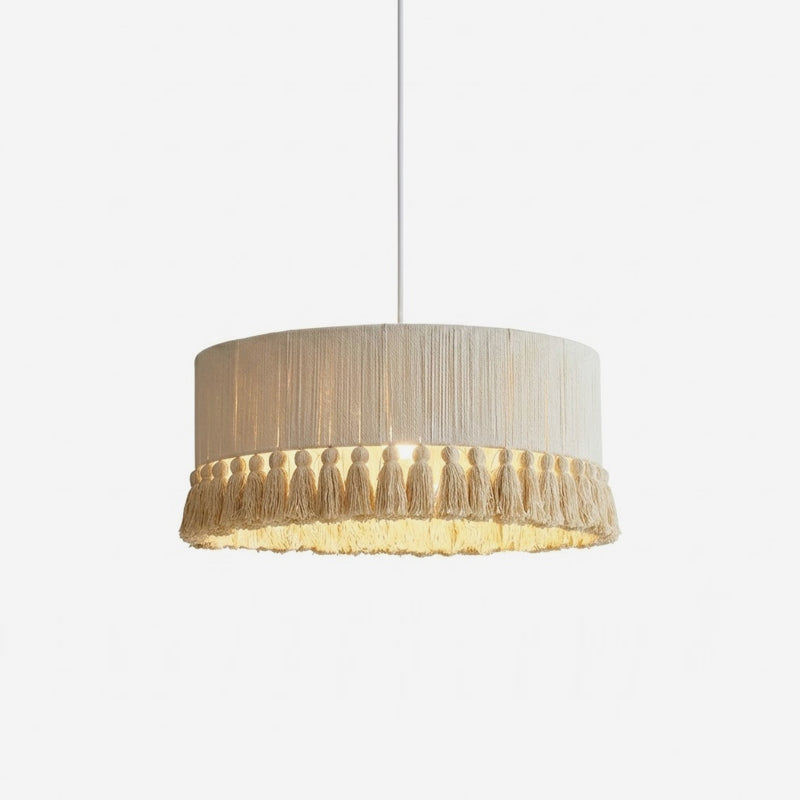
A woven dome with fringe adds movement, which naturally reduces the “blocky” feel that some shades create. The fringe detail also softens the edge line, making the pendant feel lighter and more decorative.

Why it works in small rooms:
Movement and texture distract from mass. It reads as cozy, not heavy.

How to size it:

  • Use a smaller size if your ceiling is lower or your dining space shares a room with the living area.
  • Choose a medium size if you want a focal point above the table without adding more decor.

Style tip:
This one shines in holiday season styling. Add greenery, warm candles, and let the fringe bring that “gathering” mood.

(4)Serapha Tier Pendant Lamp

A pleated look creates softness and a warm glow. The tiered form spreads light evenly while keeping the fixture from feeling like a big solid block.

Why it works in small rooms:
Pleats visually break up the surface, making the shade feel lighter and more refined.

How to size it:

  • Small dining rooms often look best with a wider shade that is not too deep. If you have size options, prioritize width over drop length to keep sightlines open.
  • If your table is compact, a smaller size still looks elegant because the pleats add detail.

Style tip:
Perfect for warm minimal spaces. Think neutral walls, simple art, and a textured rug.

(5)Floressa Pendant Lamp

This style is wide and sculptural, but it stays airy because the “petal” edges create open gaps. It spreads light across the tabletop, which is great when you want the dining zone to feel brighter without a large heavy shade.

Why it works in small rooms:
It makes a statement without forming a visual “block.” The open shape keeps the ceiling feeling higher.

How to size it:

  • For narrow rooms, pick a size that aligns with the table width rather than exceeding it.
  • If available in multiple sizes, choose the one that provides coverage but still leaves visible space around the fixture.

Style tip:
Keep the rest of the room simple. One sculptural pendant is often all you need.

(6)Breezora Pendant Lamp

A scalloped edge feels charming and timeless, and it looks especially good in smaller dining rooms because it adds personality without demanding more space.

Why it works in small rooms:
The scallop edge breaks up the outline, which makes the pendant feel lighter and less boxy.

How to size it:

  • A compact size is perfect over small round tables.
  • A larger option works well if your dining room is open concept and you want the fixture to hold its own visually.

Style tip:
This one pairs beautifully with brass details, warm wood tones, and soft seasonal decor.

FAQ

Should I choose one large pendant or two smaller ones?
For long tables or narrow rooms, two smaller pendants usually feel lighter and more balanced. For round tables, one centered pendant is often best.

What if my ceiling is low?
Choose a pendant with a shallower profile and hang it slightly higher, while still keeping enough clearance above the table. Having multiple size options helps a lot here.

How do I keep the light from feeling harsh?
Use a frosted bulb and warm color temperature, and dim when needed.

Final thought

The fastest way to elevate a small dining room is to choose a pendant that adds texture and warmth without adding visual weight. With multiple sizes available, you can get the airy look you want while still fitting your table and space perfectly.

Christmas Sale: 15% OFF 🎄
Ready to refresh your dining space for the season? Shop our woven pendant picks and choose the size that suits your room best at https://docos.us/.

Vollständigen Artikel anzeigen

When Roses Learn to Glow: The Design Story Behind the Valrosa Chandelier

Dezember 10, 2025

There’s a moment every host loves.
The table is set, the glasses catch the light, and the room suddenly feels softer, warmer—almost like someone turned up the magic. That is the moment we designed the Valrosa Chandelier for: when everyday dinners turn into little celebrations, and special occasions feel like they belong in a painting.

Hanging above the table, Valrosa looks like a blooming rose vine captured mid-climb: golden branches, sculpted leaves, and soft pink roses wrapping gently around candle-like lights. In this blog, we’d love to take you behind the scenes and show you how this chandelier came to life—from the very first sketch to the final glow.

1. The Real Moment of Inspiration

The idea for Valrosa started in the most ordinary way: with a tired bouquet in our studio kitchen.

A few days after a photo shoot, the roses we’d used on set were sitting in a vase by the window. They were past their prime, petals soft and turned slightly downward, but the color had deepened into a beautiful dusty pink. Early light from the window hit the flowers, and one of our designers paused on his way to make coffee.

He moved the vase under the pendant light and snapped a quick photo on his phone. Lit from above, the roses looked calm, full, and a little nostalgic.

That’s when the thought came:

“Our flowers fade in a week, but our lights stay for years.
What if we could keep this exact feeling and build it into a chandelier?”

He went back to his desk, opened his sketchbook, and drew a simple ring of branches with roses circling a warm center of light. Nothing dramatic, just an honest attempt to capture that quiet moment in the kitchen.
That rough sketch became the first draft of the Valrosa Chandelier.

To translate that quiet moment into a clearer visual direction, we built a simple moodboard of roses, warm light, and our key colors.

2. From First Sketch to Blooming Silhouette

Every chandelier begins with a single line on paper.

The first sketch of Valrosa showed a central stem with roses climbing around it, like a vine reaching toward the light. When the team gathered around the sketchbook, the reaction was clear:
“Beautiful—but we need more light over the table.”

So we opened the silhouette into a ring of branches instead of a single vertical stem. That way, the chandelier could:

  • Spread the light evenly across a dining table,
  • Leave open spaces so the glow could pass through, and
  • Show roses and leaves from every angle in the room.

We went through several rounds of drawing:

  • Removing extra branches that made the design feel heavy.
  • Enlarging some roses so they would still look like roses from across the room, not just small blobs of color.
  • Tucking the candle-shaped bulbs slightly behind petals, so the light would peek through like tiny flames between blooms.

Each revision brought the chandelier closer to its final personality: floral and romantic, but still clear and structured enough for everyday use.

3. Choosing Color & Material: Turning Roses into Jewelry

Valrosa needed to feel like a bouquet that never wilts—but also like a piece of jewelry for the room.

We chose a warm antique gold finish for the branches and leaves. It’s not a sharp, mirror-like gold; it’s soft and slightly aged, similar to the tone you see on old picture frames or vintage door handles. Under warm light, it glows rather than shines harshly.

For the roses, our color tests took several days. On the studio table we had:

  • A soft petal pink  
  • A slightly deeper rose pink  
  • A warm rose tone close to fresh petals

In the end, we landed on a soft petal-pink palette with a warm rose undertone. It’s gentle enough to work with white or cream walls, but it still has enough color to stand out in photos and in real life. When the light is on, the petals pick up subtle highlights along their curled edges, giving the chandelier a quiet movement even when everything is still.

The combination of antique gold metal and softly tinted roses gives Valrosa a look that feels both nostalgic and modern—romantic, but not overly sweet.

4. From 2D Drawing to 3D Light

After the sketch was approved, we moved to the 3D stage.

Using the drawing as a guide, our team built a digital model of Valrosa and placed it above a virtual dining table. This allowed us to test:

  • The overall diameter and height of the chandelier,
  • The position of each branch, leaf, and rose,
  • How the bulbs would cast light onto plates, faces, and the room around.

We rotated the model to simulate different viewpoints: someone entering the room, someone sitting at the head of the table, a guest sitting to the side. From every angle, we wanted to see:

  • A balanced composition of flowers and leaves,
  • No single element blocking too much light,
  • A natural “flow” of the vine-like branches.

Only after this digital testing looked right did we move on to building the physical prototype.

5. Handcrafted Details: A Garden Made by Human Hands

The real personality of Valrosa comes from the work done in the workshop.

Shaping the Branches

Metal rods are cut, bent, and welded by hand into organic curves. The goal isn’t perfect symmetry; it’s to mimic the way real vines twist and overlap. Each arm is slightly different, so the piece never looks factory-flat.

Sculpting the Roses

Each rose starts as soft ceramic clay. Petals are formed one by one, gently thinned, curved, and layered by hand until they resemble a rose just past full bloom—open enough to feel generous, but not falling apart. After drying, the blooms are kiln-fired to fix their shape, so every rose keeps its delicate curves for years. Because this process is done entirely by hand, no two ceramic roses are exactly the same, which keeps the chandelier from feeling alive rather than factory-perfect.

Painting & Finishing

The metal branches and leaves receive their antique gold finish in several steps, creating depth rather than a single flat color. The ceramic roses are then hand-painted in layered pink and fired again or sealed, so the colors stay soft yet durable while maintaining a gentle, matte surface.

Testing the Light

With candle-style bulbs installed, we test Valrosa in a real room—not just a laboratory setting. We check how it feels at different heights, how it photographs, and how the light falls on a set table. Our priority is always the same: beautiful first impression, comfortable long-term use.

6. Styling the Valrosa Chandelier at Home

A design story isn’t complete until the piece finds its place in everyday life. When we created Valrosa, these scenes were always in our minds:

Scene 1 – The Dining Room Garden

A simple white tablecloth, everyday plates, a small fresh bouquet, and Valrosa hanging just above eye level. The candle-like bulbs cast a warm halo across the table, and the roses overhead echo the flowers below. It turns a regular weeknight dinner into something a little more special, without feeling formal.

Scene 2 – A Soft Bedroom Glow

In a bedroom with creamy walls and linen bedding, Valrosa hangs above a reading chair or near a dressing area. At a lower dimmer setting, the roses pick up just enough light to outline their shape, giving the room a calm, romantic glow.

Scene 3 – Boutique Highlight

In a bridal studio, flower shop, or small boutique, Valrosa becomes the detail customers remember. It frames dresses, arrangements, or displays like a floating floral sculpture, helping define the brand mood the moment someone walks in.

7. Designer’s Notes: Practical Details Wrapped in Poetry

Behind the soft, romantic look, we paid careful attention to practical use:

  • Best placement
    Valrosa works beautifully over dining tables, in living rooms, bedrooms, or intimate entryways. Its floral silhouette especially suits interiors with classic moulding, neutral tones, or European-inspired decor.
  • Light & height
    Hung at the right level above a table, the chandelier offers bright yet gentle light. The open design means the bulbs can illuminate the room without feeling harsh or blocked.

  • Care & cleaning
    Most of the time, a soft, dry cloth is all you need. A gentle dusting every so often keeps the roses and leaves fresh, so your “bouquet of light” stays as charming as the day it was installed.
8. Bring the Story Home

This chandelier grew out of a simple real studio moment: a fading bouquet under warm light, turned into something you can live with every day. If you’d like to bring that same rose-lit glow into your home, our Christmas event makes it easier — all DOCOS lighting, including the Valrosa Chandelier, is now 15% off across the site.

Vollständigen Artikel anzeigen

The Science & Beauty of Alabaster: How a Raw Stone Becomes a Glowing Work of Art

Dezember 09, 2025

If you’ve ever seen a piece of raw alabaster, you might be surprised. It looks almost ordinary—chalky on the outside, a little dusty, sometimes dull and uneven. You would never guess that this same stone could glow like a soft cloud once crafted into a lamp.

That transformation is the real magic of alabaster. In this blog, we’ll walk you through the nature of this material, why it behaves so beautifully with light, and how turns a simple stone into a warm, sculptural light for the home.

1. What Exactly Is Alabaster?

Alabaster is a natural mineral, formed over millions of years through the slow settling of water, minerals, and pressure. It belongs to the gypsum family and is known for its soft, milky appearance and gentle, cloud-like veining.

Unlike marble—which is dense and heavy—alabaster has a more delicate crystalline structure. This is what gives it its special trait: it can glow.

When cut and polished to the right thickness, alabaster becomes naturally translucent. Light passes through in a soft, diffused way, creating an atmosphere that feels calm, warm, and almost ethereal.

It is 100% natural, which means every piece is slightly different. No two alabaster lamps can ever look the same—and that uniqueness is a major part of its beauty.

2. How Do Those Cloud-Like Veins Form?

One of the first things people notice about alabaster is its patterns. Some pieces have wispy white clouds, others have warm amber streaks or subtle grey lines.

These patterns are not painted or engineered. They are created by nature.

During formation, minerals flow and settle inside the stone. Variations in temperature, pressure, and mineral content create different layers, streaks, and waves. Over thousands of years, these become the soft veining we see today.

That’s why alabaster looks almost like a frozen fog—light, layered, and full of depth. When illuminated, the veins create beautiful shadows and gradients that no synthetic material can reproduce.

3. Why Can a Stone Glow? The Science Behind the Light

The secret lies in alabaster’s internal structure.

Instead of being solid or opaque, alabaster is full of microscopic crystals. When light enters the stone:

  • It doesn’t shoot straight through like glass
  • It doesn’t stop completely like marble
  • Instead, it scatters and softens, bouncing around inside the stone

This scattering effect is what creates alabaster’s signature softness. The light feels gentle, soothing, and luxurious—never harsh or direct.

The thickness of the stone also matters. A few millimeters too thick, and light gets blocked. Too thin, and the stone becomes fragile. Crafting a piece that glows evenly is a careful balance of science and craftsmanship.

4. From Raw Stone to Lamp: The Transformation

It’s easy to appreciate alabaster once it's glowing in your home, but its journey begins with a very humble-looking rock.

Here’s how transforms it:

Step 1: Cutting the Raw Block

Large blocks of alabaster arrive from the quarry—rough, uneven, and nothing like the lamps you see online.
Cutting alabaster is not as simple as cutting marble. The stone has natural fault lines and soft spots, meaning 20–30% of a raw block can be lost during the first cut alone.

If the blade angle is even slightly off—or if the stone vibrates—the entire slab may crack. Usable alabaster pieces are far fewer than the size of the original block.

Step 2: Shaping and Hollowing

Once cut into slabs, the stone is shaped according to the lamp design—round, cylindrical, square, or sculptural.
Alabaster becomes extremely fragile during hollowing. Removing too much material causes fractures; removing too little produces uneven lighting.

Different sections of the same stone may carve differently, so artisans constantly adjust pressure and technique.

Step 3: Achieving the Perfect Thickness

This is the step that determines light quality.

A difference of 0.5–1 mm can dramatically change how the stone glows:

  • Thicker → softer, dimmer light
  • Thinner → brighter, more translucent
  • Uneven → patchy or unbalanced illumination

Artisans shave the stone layer by layer, checking the glow repeatedly. If the thickness ends up wrong, the entire piece must be discarded.

Step 4: Fine Hand Polishing

The stone is sanded and polished by hand to reveal its natural veins. The goal is to keep the texture alive while smoothing the surface.

Step 5: Selecting Beautiful Veins

Not every polished slab becomes a lamp.

Many pieces reveal internal cracks, overly dense veins, or irregularities during polishing. Typically, only 10–20% of cut pieces qualify for lighting use.

Each lamp is unique because its stone is chosen for how beautifully it will illuminate.

Step 6: Combining with Metal and Fixture Components

Once the stone is ready, it’s paired with metal hardware, LED sources, or brass accents to complete the design.

When the lamp is finally turned on, the transformation becomes clear:
a rough mineral becomes a warm piece of art.

5. The Art of Contrast: Pairing Alabaster in Interior Design

Alabaster is rarely used alone. Its beauty is amplified when paired with other materials. Because the stone itself is matte and creamy, it creates a stunning visual texture when placed next to metals.

  • The Warmth of Brass: When paired with aged brass or gold, alabaster leans into its classical roots. The warm metal reflects the creamy tones of the stone, creating a look that is timeless and Art Deco inspired.

  • The Sharpness of Black Metal: For a modern twist, we often see alabaster held by matte black fixtures. The contrast is striking—the heavy, dark metal frames the soft, translucent stone, making the light appear even brighter and purer.

  • The Japandi Connection: Because alabaster is an organic material, it fits perfectly with raw wood, linen, and beige tones. It creates texture without adding visual "noise," making it a favorite in minimalist and Japandi-style interiors.

This versatility makes alabaster a "chameleon" material. It bridges the gap between the raw and the refined, fitting as perfectly in a modern loft as it does in a traditional villa.

6. Real Alabaster vs. Imitations: How to Tell the Difference

Because natural alabaster is so beautiful and requires skilled craftsmanship, it is often imitated by synthetic resins or plastics. But there is a soul to the natural stone that plastic simply cannot copy.

Here is how you can distinguish real alabaster from the fakes:

  • The Touch Test (The most reliable method): Real alabaster feels cool to the touch, much like marble or glass, even in a warm room. Imitations (resin/plastic) usually feel room-temperature or warm.
  • The Weight: Natural stone has a substantial, heavy feel. Faux versions often feel lighter, "hollow," or plasticky when lifted.
  • The Pattern: In real alabaster, the veins are random and flow naturally like smoke or clouds. In manufactured versions, you might see a repetitive pattern that looks "printed" or overly symmetrical.
  • The Translucency: Hold a light behind it. Real alabaster diffuses light with a misty, cloudy texture. Faux materials often look too transparent, flat, or uniform, lacking the internal depth of natural crystals.
7. Final Thoughts: Why Alabaster Is Worth Appreciating

Alabaster lighting is more than a design trend. It represents a rare combination of geology, craftsmanship, and light.

A stone that begins as a rough, unremarkable mineral becomes—through careful shaping, patient polishing, and precise selection—a glowing piece of natural beauty.

Great design doesn’t always come from new materials. Sometimes, it comes from discovering the hidden magic inside something as simple as stone.

Vollständigen Artikel anzeigen

🌈 Playful Living: Colorful Table Lamps That Bring Joy Into Everyday Spaces

Dezember 08, 2025

Sometimes a home doesn’t need a major makeover—just one playful lamp can change the whole mood of a room. Soft colors, charming shapes, and little details that make you smile are exactly why “Playful Living” has become such a heartwarming home trend. It’s simple, uplifting, and perfect for anyone who wants their space to feel more relaxed and expressive.

More and more young families want pieces that carry warmth and personality—not just decoration, but emotional comfort. And lighting, something we use every day, becomes even more meaningful when it feels friendly and joyful.

💫 Why ‘Playful Living’ Is Becoming the New Trend Among Young Families

Young households are shifting toward a lifestyle that feels lighter, more personal, and more emotionally supportive. Playful Living is rising quickly because:

✔ It makes the home feel warm and approachable

Whimsical shapes and soft colors help a space feel comforting instead of formal.

✔ It offers a sense of companionship

A lamp with a cute face, fun details, or a sculptural silhouette adds a small touch of company in everyday life.

✔ It lets the home reflect your personality

Younger families love décor that feels easy, fun, and expressive—something that makes the space feel like theirs.

🎨 How Colorful Lighting Transforms the Mood of a Room

Color has real power when it comes to shaping atmosphere.

✴ Soft pastels create calm

Shades of mint, peach, and light blue instantly soften a room and add a gentle, relaxing vibe.

✴ Bright colors energize

Yellows, reds, and vibrant greens bring fun and liveliness—kids especially love these cheerful tones.

✴ Playful designs add warmth

A charming base, hand-drawn patterns, or sculptural handles paired with soft light make the whole room feel more inviting.

That’s why a lamp with color and personality can shift the emotional feel of a space with almost no effort.

🌼 Featured Lamps: Playful, Colorful, and Full of Charm
1. Harvest Table Lamp — A Burst of Hand-Painted Happiness

The Harvest Table Lamp adds instant joy with its playful fruit-inspired design. Available in both apple and pear versions, each style features a cute rounded base and a softly glowing shade decorated with tiny fruit motifs. Simple, bright, and full of personality, it naturally brings warmth to any corner.

Best for: kids’ rooms, reading nooks, bedside tables, playful décor.

2. Joyvase Table Lamp — Playful Color and Charming Details

The Joyvase Table Lamp stands out with its bright, painterly color patches and double-handle vase silhouette. Its cheerful mix of hues gives it a lively, artistic feel, while the lampshade features adorable 3D flower appliqués that add a sweet and decorative touch. Soft light shines through the shade, creating a warm, inviting glow that instantly brightens the atmosphere of any room.

Best for: creative spaces, kids’ rooms, bedside tables, cheerful home décor.

3. WhimsyKit Table Lamp — Cute Character Design with a Playful Twist

The WhimsyKit Table Lamp brings instant charm with its character-inspired base and soft pastel colors. The expressive face design feels warm and friendly, while the round double handles give it a whimsical, toy-like silhouette. A 3D cat motif on the lampshade adds an extra touch of sweetness, making the lamp feel like a cheerful companion rather than just décor. When lit, it gives off a gentle, cozy glow perfect for calming bedtime or creative moments.

Best for: kids’ rooms, bedside lighting, playful study desks, cozy reading spaces.

4. Twinloop Table Lamp — Bold Geometry with a Modern Artistic Twist

The Twinloop Table Lamp stands out with its striking geometric shade and vibrant double-loop handles. The bold green base, accented with red and blue graphic lines, gives the lamp a fresh, modern energy—almost like a small piece of contemporary art. Its sculptural form makes it an eye-catching statement in any space, adding personality without overwhelming the room.

Best for: minimalist interiors, modern design lovers, entry consoles, creative workspaces.

5. Lime Twirl Table Lamp — Striped Sweetness in Four Charming Colors

The Lime Twirl Table Lamp brings a fresh, cheerful look to any room with its classic striped ceramic base and playful double-loop handles. Available in four delightful colors—blue, green, pink, and black—each version offers its own personality, from soft and sweet to bold and modern. The lampshade is accented with a cute 3D flower appliqué, adding a gentle touch of whimsy. When lit, it gives off a warm, comforting glow that enhances the cozy charm of the design.

Best for: bedrooms, sunlit corners, kids’ spaces, cottage-style décor, and any spot that needs a lighthearted, stylish accent.

💛 Final Thoughts

Playful lighting turns a regular room into a space that feels expressive, comforting, and uniquely yours. Whether you live in a spacious home, a city apartment, a dorm, or anything in between, these lamps bring:

✔ A little humor
✔ A lot of warmth
✔ And a touch of daily joy

Sometimes, happiness starts with something small—like a lamp that makes you smile every time it lights up.
And if you're thinking about brightening your home for the season, now is a lovely moment to do it—all table lamps are 15% off for Christmas.

You can explore the full collection here: https://docos.us/
Find the one that speaks to you, and let a little joy illuminate your holidays.

Vollständigen Artikel anzeigen

🎀The Art of a Ribbon: Inside the Ellery Gros-Grain Lighting Collection

Dezember 05, 2025

Some designs begin with a material; others start with a gesture. The Ellery Gros-Grain Lighting Collection is born from the union of both—gros-grain ribbon with its signature texture, and the graceful motion of tying a bow—reshaped into sculptural lighting pieces spanning a wall lamp, table lamp, and floor lamp.

What began as a study of a simple ribbon evolved into a full lighting series, each piece expressing the same poetic idea through its own scale, silhouette, and presence. The collection captures beauty in motion, preserving the quiet elegance of a tied bow in forms of light that feel both sculptural and sentimental.

1. Material — Turning Gros-Grain Ribbon Into Light

The essence of the Ellery Collection lies in transforming a soft textile into a lasting sculptural form.

Why Brass?

Brass offers the ideal balance of beauty and performance:

  • it can be heated and shaped into graceful, fabric-like curves
  • it holds those sculptural lines permanently without losing definition
  • its natural warmth enhances the “gift-like” glow of the ribbon form
  • its surface reflects light softly along the gros-grain texture
  • it is strong enough to support the open loops and delicate tails

Each bow carries the same ribbed gros-grain pattern,pressed into the brass surface to recreate the tactile feel of real ribbon.

Why These Shades?

The black shade sharpens the silhouette, adding drama.
The white shade softens the glow, creating quiet warmth.

Why These Finishes?

Brass brings a warm, nostalgic glow—similar to the richness of a wrapped gift—making the ribbon feel soft and inviting even in metal form.
Polished Nickel offers a cool, modern contrast that emphasizes the bow’s crisp lines and sculptural precision.

Material choices create emotional meaning—
a ribbon you can’t crease, fade, or untie, preserved forever in metal.

2. Proportion — One Bow, Three Interpretations

Although united by the same signature ribbon, each lamp reimagines the motif according to its function, scale, and the type of space it lives in.

The Wall Lamp — The Gesture

Mounted at eye level, the wall lamp highlights the ribbon at its most expressive moment:

  • open, airy loops
  • naturally curved tails
  • a tall tapered shade that balances the shape
  • a slim stem that keeps the bow in focus

Where it works best:
Hallways, entryways, dining rooms, bedside areas—anywhere you want a warm, welcoming accent without taking up floor or table space.

The Table Lamp — The Companion

Designed for closer interaction, the table lamp brings the bow to a more personal scale:

  • a tighter, more compact bow
  • proportions refined for desk or bedside height
  • a base with a reflective inset for added stability and polish

Where it works best:
Nightstands, consoles, home offices, living room side tables—places where you want soft, practical lighting that still feels decorative.

The Floor Lamp — The Presence

The tallest and most architectural version of the bow:

  • a long, slender stem that creates a clean vertical line
  • the bow placed at mid-height for visibility across the room
  • a crystal block base that adds weight, clarity, and stability
  • shade options that shift the mood from soft (white) to dramatic (black)

Where it works best:
Living rooms, reading corners, bedrooms, or next to accent chairs—anywhere you need height, ambient light, and a sculptural statement in one piece.

3. Craft — Freezing Movement Through Handwork

Creating a brass bow that looks light and effortless takes remarkable skill.
Each piece in the Ellery Collection goes through a detailed, hands-on process to achieve its fluid, ribbon-like form.

  • Heating the Brass

The brass is gently heated to make it pliable enough to bend without cracking, allowing artisans to shape it as gracefully as real gros-grain ribbon.

  • Hand-Shaping the Loops and Tails

Every curve is formed by hand.
This is why no two bows are ever perfectly identical—each carries its own subtle variations, just like a hand-tied ribbon.

  • Pressing Gros-Grain Texture

Fine linear ridges are pressed into the brass surface to replicate the tactile pattern of gros-grain ribbon, adding depth and enhancing how the light plays across the metal.

  • Sculpting Natural Drape

The ribbon tails are fine-tuned until they fall convincingly,
preserving the illusion of movement frozen in time.

  • Welding & Assembly

The components are welded with precision so the bow appears to float seamlessly from the stem—especially important in the taller floor lamp, where alignment and balance are crucial.

  • Finishing & Shade Pairing

Each piece is polished, finished, and paired with its shade to ensure consistency across the series, whether in brass or polished nickel.

4. Color & Finish — Three Expressions of the Same Form

Brass + Black

Dramatic, evening-forward, and sculptural.
A striking choice for dining rooms, hallways, or any space that benefits from a bold focal point.

Brass + White

Light, romantic, and inviting.The soft glow works beautifully in bedrooms, living rooms, and warm transitional interiors.

Polished Nickel + White

Modern, clean, and architectural.The cool-toned finish highlights the bow’s crisp lines and gives the piece a refined contemporary edge.

Floor Lamp Shades: White or Black

  • White creates a quiet, diffused luminosity.
  • Black adds contrast, depth, and a more atmospheric nighttime look.
05. Emotional Value — Lighting That Feels Like a Gift

What makes the Ellery Gros-Grain Bow Series truly specialis not just its materials or its craft—but its emotion.

It brings a sense of celebration into everyday life.A ribbon tied around a gift,
a gesture of care,a moment of beauty preserved in metal and light.

  • The wall lamp greets.
  • The table lamp accompanies.
  • The floor lamp elevates.

Together, they create a continuous narrative of grace,bringing softness, celebration, and artistry into everyday life.

Light, wrapped like a gift.

Vollständigen Artikel anzeigen

1 2 3 … 25 Nächste
Legal
  • Urheberrechte ©
  • Datenschutzrichtlinie
  • Rückgaberecht
  • Versandbedingungen
  • Nutzungsbedingungen
  • Legal Policy
Melden Sie sich für unseren Newsletter an

Melden Sie sich an, um die neuesten Informationen zu Verkäufen, Neuerscheinungen und mehr zu erhalten …

Kontakt

Häufig gestellte Fragen
Kontakt
Zahlung
Unsere Geschichte
Bestellung verfolgen


© 2026 Docos. Powered by Shopify

Ach Direct Debit Amazon American Express Apple Pay Diners Club Discover Google Pay Mastercard PayPal Shop Pay USDC Venmo Visa